Menu Content/Inhalt
Home

Polls

How do you get your electronic parts?
 

Login Form


Lost Password?
No account yet? Register

Syndicate

Rebuilding my Amiga
Monday, 17 November 2008
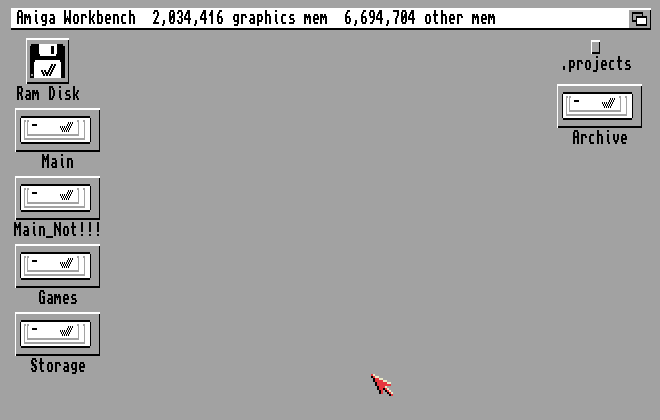
I have been an Amiga fanatic ever since the Amiga 1000 came out.
 
I have been an Amiga owner since I got my Federal Tax refund in February 1989. I had bought a Commodore Amiga 500 using nearly all of the refund money. It cost $599, and I had to wait for it to be shipped to me. I bought it at a Games & Gadgets (remember those stores, sister store to Electronics Boutique). I had to order and pay at the store and wait 7-10 days for delivery.
 
Oh, the anticipation...!!!!  I had my fully loaded Commodore 128, 1541 and 1571 disk drives, Sears brand RGB monitor. I was a big Commodore geek. I was fully immersed in what I already had. Yet, I was outgrowing it and in desparate need of more. More power, more colors, better graphics!!!!


Last Updated ( Thursday, 20 November 2008 )
 
Read Error - Saving my disk collection
Friday, 03 October 2008
Image
Years and years of sitting around in storage. Are my disks a lost hope? I'm looking for some help and suggestions. I have hundreds of 3.5" floppy disks from my Amiga days. For the longest time, I didn't have an Amiga with a working disk drive. I also wasn't able to sucessfully adapt a modern PC floppy drive.
 
Here's a bit of history. I retired my Amiga 500 when the floppy drive went bad and I outgrew the software I had on the installed 100MB hard drive. I put all the disks in an ordered fashion in a large cardboard box. That was back in 1996. Over the years, the box moved from one house to another and has been subject to temperature and humidity changes. Recently, I acquired an Amiga 2000 with two working floppy drives (or so I think). I pulled out a few of my old Amiga disks and tried them in the 2000. I get a spine tingling screeeechhhhing sound as the disk spins, followed by the disconcerting DF0:BAD icon.
 
I tried a few other disks and they result in the same behavior, using both floppy drives. I proceed to look inside the drives through the front, with a flashlight, to see what may be going on. I removed a few dust bunnies from the drive, although they don't seem to have been in a position to cause the noise, or any sort of read problem. I tried a 3.5" disk cleaner and was able to read one disk with a high degree of accuracy. After trying another one, which failed, and going back to the newly working one, the working one failed to read again. This confused me.
 
Upon examining the media under the sliding cover, I have a theory that all of the disks may have developed some sort of very thin film of debris obstructing the read heads. That coating may have reduced the sleekness of the meda surface, causing the "fingers on a chalkboard" screeching instead of a smooth floating of the read heads on the surface.
 
I also have a theory that my original disk drive may have been out of alignment. Of course, all my disks would still work on a properly "mis-aligned" drive, but fail on a factory aligned drive. That would mean these disks would need an equally out of alignment drive to be read correctly. So, the big question now is, what do I do about it? My first plans are to remove the disk drives, open them up, and completely clean and lubricate the mechanisms. We'll see if that helps to improve disk reads. Next, I may have to find a way to clean a possible film off the disks themselves. My first idea is to use the cleaning disk case as a replacement disk shell. the cleaning disk opens up to allow the fabric disk to be removed. If I split the end of a floppy disk, I can slide the magnetic media out of it's original case and put it in the cleaning disk shell. While the media is out, I could clean it with a non residual cleaning agent or alcohol.
 
As far as the mis-alignment theory, I have an oscilloscope. I should theoretically see the signal on the read head as it's reading and possibly adjust the head position until I get the strongest signal. Adjusting a drive using this method is a lost art. Does anybody know what the signal is supposed to look like on an oscilloscope? I'll only try to intentionally mis-align a standard PC floppy drive instead of a rare 880K Amiga drive. If I can get the PC floppy drive reading the Amiga disk with a good signal, I can try hooking up that drive to the Amiga and have a method to archive my disks. Or, I could use ADFREAD on a PC to do the trick. ADFREAD shows read errors as it tries to backup Amiga disks to .ADF files. I'll know if the alignment change is successful.
 
Any other theories or successful experiences out there?

Last Updated ( Friday, 03 October 2008 )
 
Merlin!!!
Sunday, 02 March 2008
Image
Merlin in all its glory
Merlin was made by a company called Parker Brothers back in 1978. It's about the size of a man's shoe and looks kind of like a telephone that's red and burgundy in color  There's a built in speaker at the top end and two sets of flat, membrane style buttons. One set of buttons is a numeric keypad with the numbers 0 thru 10, laid out like a pushbutton telephone but with buttons zero and ten above and below the numeric keypad. On the lower end of the game are four buttons labeled New Game, Same Game, Hit Me, and Comp Turn (which is used to indicate when it's the computer's turn to play).
 
Click Read More below for more details and feel free to leave comments about the article.

Last Updated ( Sunday, 02 March 2008 )
 
<< Start < Prev 1 2 Next > End >>

Results 1 - 4 of 8

Newsflash

I'm going through a lot of old, salvage equipment. I'm finding all sorts of parts, both electronic and mechanical. Some of them I'm keeping. The rest will be posted for sale on this website in the near future.